Approx. 3300 BC. Celtic - tattoos on "Iceman's" Skin
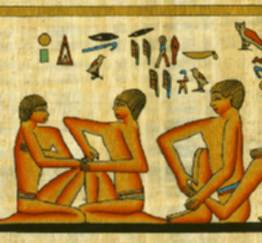
Approx. 2300 BC. Egypt - reflexology painting in the physicians' tomb
in Saqqara
Approx. BC 400th China - Wang Li documented reflexology
Approx. AD 500th Maya culture - reflexology panels carved in stone
Selected modern
developments:
1670 Philippi Meyen - signs on nails and fingers
1834 W. & D. Griffin - connection between body disorders and
spine reactions
1873 von Peczely - systematic mapping of sign in the iris
1875 Lange - relationships of organs to skin areas
1883 Voltolini - discovery of changes in the nasal mucosa at
disturbances of reproductive organs
1886 Weihe - pressure points that are associated with diseases and
homeopathic remedies
1893 Head - segmental spine relations with the dermatomes
1893 Mackenzie - muscle allocations to the segments
1893 Fliess - extensive use of the nasal reflexology zones
1910 Fitzgerald - specific use of the reflexology at the feet and hands
1928 Huneke - neural therapy e.g. in the dermatomes
1929 Dieke - begin of the connective tissue massage in the dermatomes
1930 Ingham – modification of Fitzgerald's zone system
1950 Vogler - sclerotomes: zone allocation to the periosteum
1952 Nogier - reflexology at the ear - auriculotherapy
1957 Strobl - reflexology on the tongue
1958 Cornelius - nerval points massage
1960 Adler - lymphatic reflexology points on the neck
1960 B. und K. Kunz - spread of reflexology at the feet in America
1960 Marquardt - spread of reflexology at the feet in Europe
1968 Voll - relationship of the teeth with the organs
1970 Voll - somatotopy on the metacarpals (hand line I –
thumb - lymph)
1975 Yamamoto - somatotopy on the head
1975 Gleditsch / Mandel - tonsils' lymph belt
1978 Zeitler - reflexology on the scull
1980 Mandel - Kirlian terminal point diagnostics
1983 Gleditsch - first overall view of reflexology somatotopies
1985 Zhang - somatotopy on metacarpal II (hand line II - ECIWO)
1985 Buchheit - vaginal somatotopy
1989 Siener - new punctual pain and organ therapy (NPSO®)
1990 Gleditsch - somatotopy on metacarpal V (hand line V)
1991 Yamamoto - somatotopy e.g. on the forehead, back of the head and
abdomen
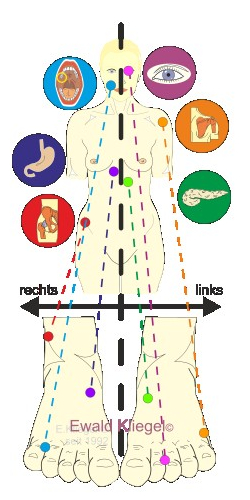
The three-dimensional structure of the human body can be directly
traced in the reflexology zones of the hands and feet. Three simple
rules apply:
1. Left-Right Rule:
Right-sided organs are found on the right hand and right foot, and
those on the left side on the left hand. The body's mid line lies
between the thumbs placed together. The right shoulder is therefore at
the outer edge of the right hand, and the wisdom tooth is between the
left middle and ring fingers.
2. Front-Back Rule:
All organs on the front of the body, such as the nose or abdomen, have
their reflex zones on the back of the hand or top of the foot, and all
rear organs, such as the neck or bottom, are on the palms and soles of
the feet. Internal organs and joints can be reached on both sides.
Thus, a painful shoulder joint as well as a wisdom tooth are
represented on both the top and bottom of the hand and foot.
3. Floor Rule:
The body is represented in a three-dimensional image on the hand and
foot reflexology zones. The guides for this are our spinal column
segments.
"Metabolism" is a term that is frequently used and often remains
misunderstood. More precisely, there are actually three metabolic
systems that are closely interconnected.
The first place where substances are exchanged is at the boundary
layers of the digestive system, where processed food is absorbed into
the body, indigestible matter is passed through, and the remainder is
expelled.
Another exchange of substances occurs at the cell membranes, where
oxygen, nutrients and other vital substances are passed into the
interior of the cell and the processed residues are expelled from the
cell.
The third and therapeutically essential metabolism takes
place between
the first two. This refers to what Pischinger described as the basic
regulatory system, which represents a key function of the connective
tissue. Connective tissue "is the largest system running throughout the
organism as a whole" (Schlebusch), a framework weighing up to twelve
kilos, filled with tissue fluid, in which the cells are embedded. Since
the body's 50 trillion cells cannot be supplied individually, evolution
has developed a pool system – our inner primordial sea. The
substances brought in from the vessels are released into the connective
tissue, where they then reach the cells through diffusion and active
transport processes. Conversely, the cells release the waste products
of their intracellular work into the inner primordial sea as well.
There, the lymphatic system ensures their transport for recycling or to
the organs of excretion. By now it should be clear that this metabolic
system represents the central life element of the cells and that the
well-being of the cells depends on its quality.
If this metabolism is burdened by too many toxins, drug
residues,
environmental poisons or poor nutrition, the cells suffer. In a clean
environment, however, the cells are optimally nourished. In a clear
primordial sea, excellent information exchange is also ensured, which
exists through biophoton communication between the cells (according to
Popp).
A well-functioning metabolism is a fundamental factor for successful
reflexology work. Therefore, all measures in the reflexology must be
supplemented and accompanied by metabolism-relieving treatments. Only
then can the organism adequately respond to reflexology impulses. Use
the possibilities of naturopathy to support metabolism. These
treatments make a significant contribution to a holistic reflexology
treatment.
The human being is a unit in which every part is connected to every
other part. Our toes are supplied by the same blood as our hair roots
and the nerve impulses in our body are controlled in such a way that
even the smallest movements of our head automatically trigger fine
adjustments of our foot muscles.
According to current knowledge, the main factors responsible for the
reflex zones are the autonomic nervous system and light communication
via biophotons.
The autonomic nervous system, with a total length of about 10 times the
circumference of the Earth (approximately 400,000 km), is comparable to
a telephone landline network through which emails are sent from the
organs to the reflex zones and back. It is present in all human
structures, enveloping all blood vessels as a fine network and
branching out with its many end knobs in metabolism. Additionally, the
autonomic nervous system in the abdominal area has developed several
large nerve plexuses that control all internal organs. These nerve
clusters collectively form a kind of second brain that follows our
basic motivations: towards food, reproduction or pleasure –
and away from pain, discomfort or threat.
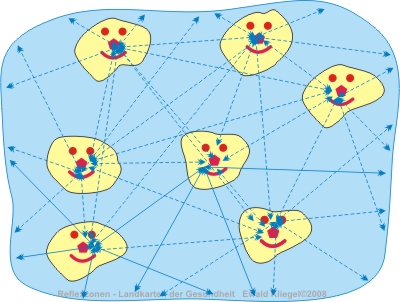
All
our cells can only fulfil their tasks through cooperation and
coordination. According to Prof. F.A. Popp, the cells communicate with
each other using biophotons, ultra-weak laser light. While we can
compare the autonomic nervous system to a kind of internal telephone
landline, the light communication of the cells corresponds to an
internal mobile network, in which our 50 trillion cells send messages
to each other. In modern communication networks, we cannot predict the
exact path a message will take. This also applies to our internal
communication systems. If at times quite significant scientific
opinions hold the view that there is no demonstrable 'connection'
between an organ and its reflex zones, it should be noted that the
existence of reflex zone effects has been demonstrated in various
sufficient studies. How humans organise internally for impulses to
arrive would be an interesting field of research, which is also always
open to the aforementioned critics.
Pain is a mysterious phenomenon, which already begins with its
definition. Although everyone has experienced this tormenting sensation
at some point, we have always found it difficult to define pain. When
the ancient Greeks said that it was a 'barking watchdog of health,' we
must therefore also attribute a positive intention to this unmistakable
signal. In contemporary terms, this means that pain has a protective
function.
Up until now, the search for a pain centre in the brain or elsewhere
was largely in vain, but since the 1960s, science has increasingly
provided evidence with the Gate Control Theory (according to Melzack
& Wall 1965) that perceived pain is the result of impulse
calculations. The various impulses are weighed against each other on
their way to consciousness. This also explains why, for example,
relaxation techniques, meditation and reflexology treatments can
alleviate pain.
However, let us take a closer look at the most common type of pain,
that of the musculoskeletal system. Here we can see that it requires a
combination of several factors to perceive pain. The disturbances must
exceed a certain individually varying intensity, affect a sensitised
area and overwhelm the system's compensatory capacity. Only then do
pain responses acquire a pathological significance.
An event such as pain, which involves so many factors, follows laws
that we know from all dynamic processes. Health and illness also belong
to this category. What they have in common is that there is no absolute
measure, but a fluid equilibrium that is constantly readjusted by
internal and external changes. As far as pain in particular is
concerned, there is neither a universally valid pain threshold nor is
pain unchangeable. On the contrary, it is precisely pain that, by being
reassessed at each junction, offers a multitude of possibilities. One
of these is reflex zone treatments, which, in combination with other
measures, provide a wide range of interventions for such tormenting and
distressing experiences.
An example of this would be referred pain. This refers to areas of skin
sensitive to pain, muscles, joint capsules or fascia that arise due to
our brain 'miscalculating' and making an incorrect assessment of a
location. An example of this would be when a scar in the shoulder area
causes a disturbance, but this location is perceived in the cerebral
cortex as pain in the acromioclavicular joint. Somewhere in one of the
relay points, an error in impulse calculation has crept in. Pain
assigned
segmentally to the same level is perceived elsewhere.
A good aid in this regard are the dermatomes, myotomes and sclerotomes.
In 1999, the scientists Drs. Sudmeier, Bodner, Egger, Mur, Ulmer and
Herold from the University Clinic Innsbruck published a study entitled
Change in renal blood
flow measured by colour-coded Doppler sonography through
organ-associated reflex zone therapy on the foot.
In this placebo-controlled study, the researchers administered massages
to the right soles of 17 women and 15 men. Half of the participants had
the zone of the right kidney massaged, while the other half received
massages on the zones of the sinuses and ears.
After an initial measurement of the right renal artery flow rate, the
feet were massaged. Neither the participants nor the practisers knew
which zones were being massaged. A second measurement was taken during
the treatment after 2 minutes and a third measurement of renal blood
flow was taken 6 minutes after the end of the massage.
The result was clear. In the group whose kidney zones were massaged,
there was a significant change in the renal artery. According to the
study, this "corresponds to a reduction in resistance in the renal
vascular system and indicates an increase in blood flow. The results
support the hypothesis that organ-associated reflex zone therapy on the
foot temporarily positively influences renal blood flow."
In the discussion, the authors go even further, suggesting that the
hope for longer-term effectiveness after a series of treatments is
certainly justified.
Given the cautious scientific statements, this result is a milestone in
the recognition of foot reflexology, as this study shows that the organ
locations on the feet, which have been proven through millions of
experiences, are also scientifically reliable.
Further interesting
studies
Universität Ulster - Reflexology
for the treatment of pain in people with multiple sclerosis (Okt.
2009)
Universität Jena - Wirksamkeit der
Fußreflexzonentherapie bei Gonarthrose belegt
(Juni
2006)
Further sources:
http://www.internethealthlibrary.com
The UK's largest Alternative Medicine,
Complementary Therapy and Natural Health Care Resource. In the Library,
you will find all of our services are FREE! This includes access to
Medical Research where we provide access to the medical databases where
you can find out about ANYTHING that has been been published in medical
journals all over the world.
Reflexology Research Project - Kevin and
Barbara Kunz USA
What you will find here represents the work
of Barbara
and Kevin Kunz, internationally recognized authorities in reflexology.
Barbara and Kevin have been professional hand and foot reflexologists,
researchers, authors and innovators for over 30 years. Original foot
and hand reflexology charts and information.